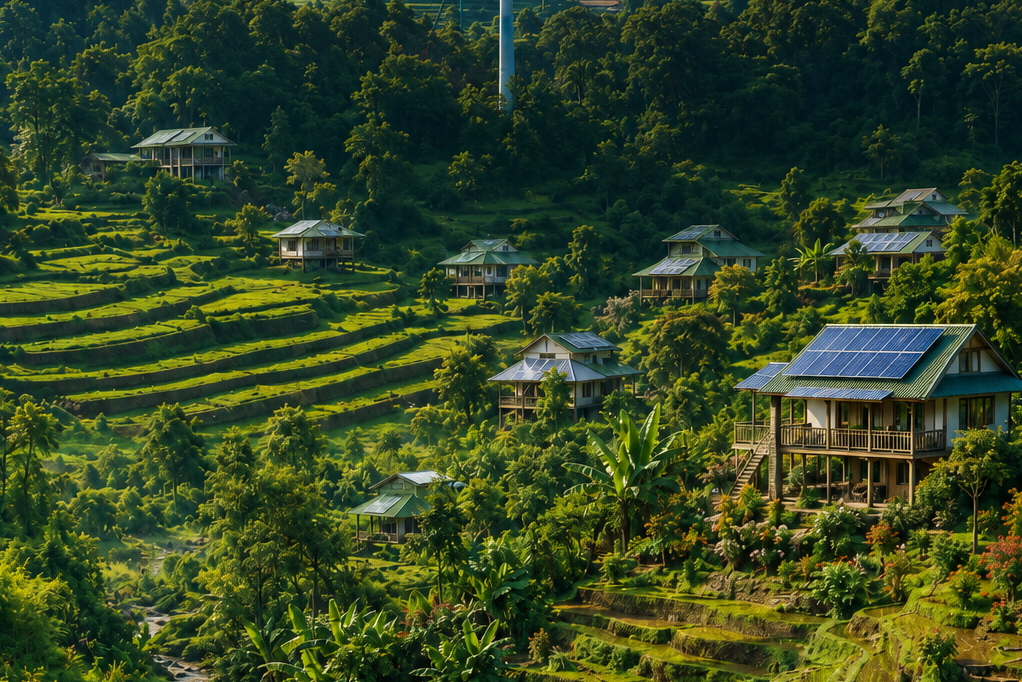
Pathways to a Habitable Future—In Action is a year-long program of thinking, discussion, research, and action at a bioregional level, using the Genesee Finger Lakes as an example. It is based on the Possible Planet book as a basic starting point for an exploration of practical action. Here’s some of the background to this thinking.
I’d like to incorporate two further ideas into this. The first is that we need to start at home. In our own case this has meant the creation of “Elwell Eden,” the transformation of our quarter-acre lot from chemlawn to food forest, with all kinds of co-benefits. The second is that an ultimate goal is the creation of a Bioregional Assembly, followed by a permanent Bioregional Council, that can advise local and county governments on Bioregional matters.
These two ideas supply the missing vertical architecture. Living the Book would begin with the regeneration of actual homes and landscapes, then connect those efforts until participants are capable of speaking—and deliberating—at the scale of the bioregion.
A revised guiding phrase might be:
Begin at home. Learn from the land. Organize by bioregion. Build a better Earth today.
flowchart TD
    A["Homes and demonstration sites"] --> B["Neighborhood learning networks"]
    B --> C["Watershed and place circles"]
    C --> D["Bioregional Assembly"]
    D --> E["Permanent Bioregional Council"]
    E --> F["Advice to local and county governments"]
    F -. "Response and partnership" .-> E
Elwell Eden as the starting story
Elwell Eden gives the program something indispensable: a visible example of regeneration already underway.
The transformation of your quarter-acre lot from chemical lawn into a food forest demonstrates that regeneration is not merely a global policy objective. It can begin outside the front door. Its co-benefits include:
- Food, herbs, flowers, and other useful plants.
- Soil restoration and elimination of routine chemical treatments.
- Pollinator, bird, and other wildlife habitat.
- Greater water infiltration and less runoff.
- Shade, cooling, beauty, and contact with nature.
- Household resilience and practical learning.
- Opportunities for children, neighbors, and visitors to participate.
- A changed relationship with the place one inhabits.
Elwell Eden should not be presented as a perfect model everyone must reproduce. It is a living experiment, including its maintenance demands, mistakes, adaptations, and surprises. That honesty will make it more persuasive.
Nor does “start at home” require owning a quarter-acre. Home-scale action might mean a balcony, apartment building, rented yard, community garden, school, faith community, street, or neighborhood commons. The principle is:
Start with the place you can know, care for, and influence directly.
Each participant or household could create a simple Home-to-Habitat Plan. It would ask:
- What is here now?
- What flows through this place—water, energy, food, waste, wildlife, money, and people?
- What is already healthy?
- What could become more life-supporting?
- What is one change we can make this year?
- Who else could participate?
Participants who cannot undertake a physical landscape project could focus on food, energy, waste, mutual aid, children’s learning, local purchasing, or institutional change.
Two continuing tracks
Rather than adding Elwell Eden and the Bioregional Assembly as two more monthly topics, I would make them continuing tracks running through all twelve months.
1. The Living Places Track
Participants transform or support a home, school, neighborhood, stream, garden, business, or other tangible place.
Elwell Eden becomes the founding demonstration site. Over the year, other sites become part of a distributed network of “living landscapes.” These could be shown on the GFLBioregion.org map, with a photograph, brief description, ecological features, lessons learned, and opportunities to visit or volunteer.
2. The Bioregional Commons Track
Participants gradually build the knowledge, relationships, and civic legitimacy required to convene a Genesee–Finger Lakes Bioregional Assembly.
The Assembly would not merely discuss regeneration. It would deliberate on evidence, identify shared priorities, and create the mandate and initial charter for a permanent Bioregional Council.
The two tracks continually inform one another. Home and neighborhood projects reveal what is possible and what obstacles people encounter. The Assembly converts those experiences into regional recommendations, partnerships, and policy proposals.
The revised year-long progression
Months 1–3: Begin at home and rediscover place
Elwell Eden opens the program as a story of reinhabitation. Participants create Home-to-Habitat Plans, choose their Living Projects, and begin mapping their relationships to land, water, food, energy, neighbors, and future generations.
The bioregional track introduces the Genesee–Finger Lakes Living Bioregion Model and asks: What defines our region ecologically, socially, economically, and culturally?
The children-and-future-generations month remains important. Children might help inventory birds and pollinators, draw maps, imagine future neighborhoods, plant gardens, or interview elders about how the landscape has changed.
First-quarter outcome: A network of participating homes and projects, each with a baseline, aspiration, and first action.
Months 4–6: Connect homes into living landscapes
The water, landscape, food, biodiversity, and climate months become opportunities for collective fieldwork. Participants visit demonstration sites, undertake water walks, join restoration projects, exchange plants and skills, and identify landscape connections that cross property lines.
Elwell Eden could host a seasonal open house or “Living Landscape Day.” Other participants could hold smaller neighborhood tours.
The emerging network would begin documenting common barriers—lawn ordinances, lack of knowledge, costs, invasive plants, stormwater rules, access to land, nursery availability, or neighborhood expectations. These become potential subjects for bioregional policy work.
Second-quarter outcome: Several visible projects, a preliminary living-landscapes map, and a list of barriers and opportunities requiring broader coordination.
Months 7–9: Move from projects to systems
The economy, biomimicry, energy, buildings, and right-livelihood months ask what systems must change so that regenerative choices become easier and more affordable.
Participants might investigate:
- Municipal landscaping and pesticide policies.
- Native-plant and food-forest programs.
- Stormwater incentives and watershed restoration.
- Community composting and food-waste recovery.
- Green infrastructure and building improvements.
- Local procurement and regenerative enterprises.
- Training and employment in ecological landscaping, energy, food, and restoration.
- Financing mechanisms for household and community resilience.
During these months, the program would hold listening sessions with farmers, youth, educators, Indigenous representatives, environmental-justice communities, conservation groups, businesses, municipalities, universities, planners, and neighborhood organizations.
Third-quarter outcome: A draft State of the Bioregion briefing and three to five issues suitable for deliberation by the Assembly.
Months 10–12: Convene the bioregion
The final quarter concentrates on representation, resilience, governance, and planetary intelligence.
Month 10 develops the Assembly’s ethical and representational foundations. Indigenous Nations should be approached as sovereign peoples and potential partners—not treated simply as another stakeholder category. Deliberate outreach would also be needed to include rural communities, environmental-justice neighborhoods, youth, farmers, workers, municipalities, and people not already part of the ecological movement.
Month 11 can conduct a practice deliberation, testing the materials and facilitation.
Month 12 becomes the inaugural Genesee–Finger Lakes Bioregional Assembly. It would hear the year’s stories, review regional evidence, deliberate on selected priorities, and propose the structure of the permanent Council.
Year-end outcome: A public Bioregional Compact, an initial set of recommendations, and a mandate to establish the Council.
The Bioregional Assembly
The first Assembly should be broad, public, and carefully facilitated. It might include open participation alongside deliberately recruited or randomly selected resident participants to avoid becoming a meeting solely of established environmental advocates.
Its purposes would be to:
- Share a comprehensible picture of bioregional conditions.
- Hear from communities and practitioners.
- Identify common concerns across municipal and county boundaries.
- Deliberate on several actionable proposals.
- Adopt a short Bioregional Compact.
- Establish the mission, representation, and accountability of the permanent Council.
It should initially be understood as a civic advisory assembly, not a competing layer of government. Its influence will depend on inclusion, credible evidence, transparent deliberation, and constructive relationships with existing institutions.
The permanent Bioregional Council
The Council could consist of approximately 18–24 members with staggered terms, balancing:
- Watersheds and geographic subregions.
- Urban, suburban, and rural communities.
- Youth and future-generations representation.
- Environmental-justice communities.
- Indigenous participation developed through proper relationships.
- Agriculture, restoration, health, education, economy, and infrastructure.
- Municipal and county liaisons.
- Residents selected through an open or civic-lottery process.
Its recurring work could include:
- Publishing an annual State of the Genesee–Finger Lakes Bioregion.
- Maintaining the Living Bioregion Model and public indicators.
- Advising local and county governments.
- Preparing concise policy and investment recommendations.
- Connecting projects across jurisdictional boundaries.
- Convening an annual or biennial Assembly.
- Tracking whether governments respond to its recommendations.
- Identifying opportunities for collaborative funding and implementation.
To have real influence, the Council should seek formal arrangements under which municipalities and counties agree to receive its annual report, place recommendations on relevant agendas, and provide written responses. That is more consequential than simply issuing reports and hoping someone reads them.
The Council should also complement the Genesee/Finger Lakes Regional Planning Council and other existing bodies, not duplicate them. Its distinctive contribution would be to organize knowledge and public deliberation around ecological boundaries, long-term habitability, lived community experience, and the interests of future generations.
A strengthened ultimate goal
The program’s goal can now be stated more concretely:
Living the Book will help people regenerate the places where they live, connect those places into a learning bioregion, and create a permanent civic voice for the health and future of the Genesee–Finger Lakes region.
Elwell Eden is the seed. The participating homes and projects become the mycelial network. The Assembly allows the bioregion to deliberate. The Council gives that emerging intelligence continuity and a public voice.