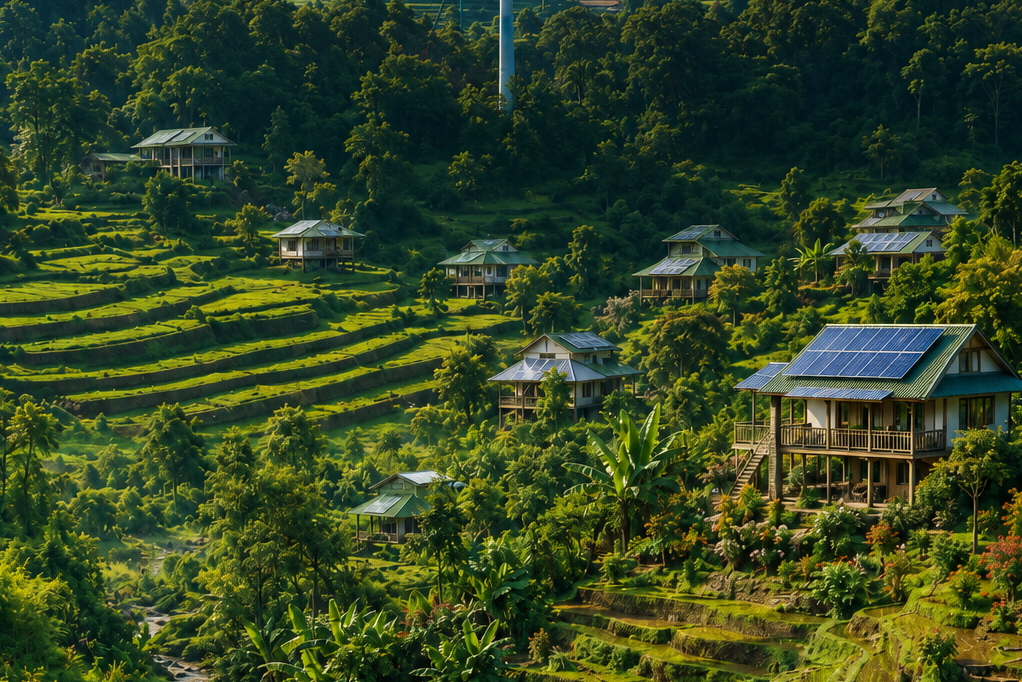
Inhabitation: The Next Question for a Possible Planet
We often speak about sustainability, resilience, regeneration, and restoration. Each word has value. But beneath them all is a deeper question:
How shall human beings inhabit the Earth?
Not merely occupy it. Not merely extract from it. Not merely protect fragments of it from ourselves. But inhabit it: dwell within the living systems that sustain us in ways that increase their vitality, beauty, diversity, and capacity for renewal.
This is one of the central questions of Possible Planet: Pathways to a Habitable Future. The book argues that the future is not yet decided. Collapse is possible. So is renewal. But renewal will not come from technology alone, policy alone, markets alone, or even restoration projects alone. It will require a transformation in how we understand our role as a species.
For too long, modern civilization has treated land as real estate, nature as resource, and communities as labor pools or consumer markets. Even much environmental thinking has accepted the separation between “human systems” and “natural systems,” as though the task were simply to reduce the damage caused by one to the other.
But the deeper task is different. We need to become a life-enhancing presence.
That begins with a shift from development to inhabitation.
Development asks: What can be built here?
Inhabitation asks: What does this place need in order to become more alive, and what forms of human presence would help that happen?
This question is especially urgent now because so much of the Earth has been degraded, abandoned, fragmented, or misused — not because humans are inherently destructive, but because our institutions, incentives, and stories have taught us to live badly. Across rural landscapes, urban neighborhoods, refugee settlements, former industrial sites, damaged watersheds, and overextended suburbs, there are opportunities to restore both ecosystems and human dignity.
But we must be careful. Inhabitation is not a new version of conquest. There is no such thing as “empty land” in the old settler-colonial sense. Every place has a history, a watershed, a climate, a biotic community, and often a long human memory. To inhabit wisely is to enter into relationship with those realities, not overwrite them.
This is where the idea of planetary intelligence becomes essential.
Planetary intelligence is not simply artificial intelligence applied to global problems. Nor is it the fantasy of a single planetary brain. It is the emerging capacity of human societies to perceive ecological reality, learn across scales, remember consequences, correct mistakes, and coordinate action in service to life.
That intelligence must be grounded in place. It must be bioregional before it can be planetary.
A bioregion is not just a geographic area. It is a living context: watersheds, soils, forests, farms, species, cities, cultures, food systems, economies, and histories interwoven over time. To think bioregionally is to ask how people can meet more of their needs within the carrying capacity and character of the places they inhabit.
This is why the work of organizations such as the Design School for Regenerating Earth, the EcoRestoration Alliance, and the emerging Planetary Intelligence community matters so much.
The Design School for Regenerating Earth has been helping people understand regeneration as a cultural, ecological, and bioregional process. Its “Dandelion Strategy” points toward a distributed model of change: seed local capacity, connect learning communities, and let regenerative practice spread through relationship rather than command.
The EcoRestoration Alliance is helping make visible the thousands of restoration efforts already underway around the world. Its mapping, convening, and support for local projects show that regeneration is not an abstraction. It is already happening — in farms, forests, riverbanks, villages, refugee camps, and urban margins. The question is how these efforts can learn from one another and become more than isolated good works.
The Institute for Planetary Intelligence, now emerging alongside the broader Possible Planet work, can help frame the next step: how do scattered regenerative efforts become a coherent learning system without becoming centralized, bureaucratic, or extractive?
That may be the most urgent question before us.
The future will not be saved by one master plan. Regeneration will not scale like software. It will spread more like mycelium, seed, language, apprenticeship, watershed restoration, and cultural memory. It requires pattern recognition, but not uniformity. It requires technology, but not technocracy. It requires metrics, but not the reduction of living communities to data points.
The work ahead is to connect restoration, bioregional learning, ecological design, community finance, Indigenous wisdom, public policy, and AI-enabled tools into a more intelligent whole.
Small grants, for example, should not be judged only by how many trees are planted or how many acres are treated. They should also be understood as learning probes. A well-designed project should improve local conditions, strengthen community agency, and teach the larger network something about what works, what fails, and what can be adapted elsewhere.
The same is true of ecovillages, food forests, watershed alliances, regenerative farms, neighborhood resilience projects, and bioregional hubs. Each is more than a project. Each can become part of a planetary learning ecology.
This is the deeper meaning of inhabitation.
To inhabit is to belong responsibly.
To inhabit is to ask what a place is asking of us.
To inhabit is to restore the feedback loops between land, livelihood, culture, and governance.
To inhabit is to recognize that human beings are not outside nature, but neither are we automatically beneficial within it. We must learn how to become beneficial.
That learning is now a civilizational task.
Possible Planet was written as an invitation into that task. It is not a prediction that everything will work out. It is an argument that a habitable future remains possible if we can align our intelligence, institutions, technologies, and imaginations with the conditions of life.
The next frontier is not merely sustainability. It is not even restoration in the narrow sense.
It is inhabitation.
How do we live here — on this Earth, in these watersheds, within these limits, among these beings — in a way that makes the world more alive?
That is the question that should guide us now.
To learn more about Possible Planet: Pathways to a Habitable Future and the wider work emerging around planetary intelligence, bioregional regeneration, and ecological restoration, please visit the Possible Planet book site.
“Development asks what can be built here. Inhabitation asks what kind of human presence would make this place more alive.”